A measurement method that uses an LD attached to a flying slider and a semitransparent rotating disk mirror for an ESEC (Extremely-short-external -cavaty length) configuration is presented. Not only the wavelength, but also the spectrum and the light output are measured at room temperature, with the external-cavity-length Lex, the reflectivities of the LD facets and external mirror, and the drive current as parameters. As a result, wavelength tuning as great as 30 nm by varying the external-cavity length is confirmed for a 1.3-mm-wavelength LD with an antireflection coating on the LD facet facing the external mirror.
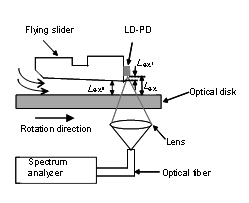
Fig. 1. Proposed setup for measurement of wavelength tuning based on ESEC length. An LD attached to an air-bearing slider flies by air resistance caused by disk rotation (upside down in reality)
 Some aspects of the feedback effect for an ESEC LD configuration are measured by the following method. An extremely short external cavity was realized when an LD on a slider flew on a semitransparent optical disk. Figure 2(a) illustrates the experimental setup (upside down in reality) for monitoring the wavelength-related behavior of an LD by means of an integrated photodiode (PD) which is mounted on a flying slider. The InGaAsP/InP LD is isolated from the PD by reactive ion beam etching. The cavity length of the LD is 300 mm and the space
between the LD and the PD is 5 mm. The monitor current sensitivity is 0.1 mA/mW.
Some aspects of the feedback effect for an ESEC LD configuration are measured by the following method. An extremely short external cavity was realized when an LD on a slider flew on a semitransparent optical disk. Figure 2(a) illustrates the experimental setup (upside down in reality) for monitoring the wavelength-related behavior of an LD by means of an integrated photodiode (PD) which is mounted on a flying slider. The InGaAsP/InP LD is isolated from the PD by reactive ion beam etching. The cavity length of the LD is 300 mm and the space
between the LD and the PD is 5 mm. The monitor current sensitivity is 0.1 mA/mW.
Fig. 2. Detailed representation of the ESEC LD system (a), and photograph of a monolithically integrated LD-PD chip on a slider (b)